Comparison of Modified Ferriman-Gallwey Score and Biochemical Parameters in the Estimation of the Prevalence of Idiopathic Hirsutism Among Women in the Kurdistan Region
DOI:
https://doi.org/10.47419/bjbabs.v4i03.259Keywords:
Hirsutism, Sex hormones , PCOS , Androgens , Prevalence , Etiology , Hyperandrogenism , Modified Ferriman-GallweyAbstract
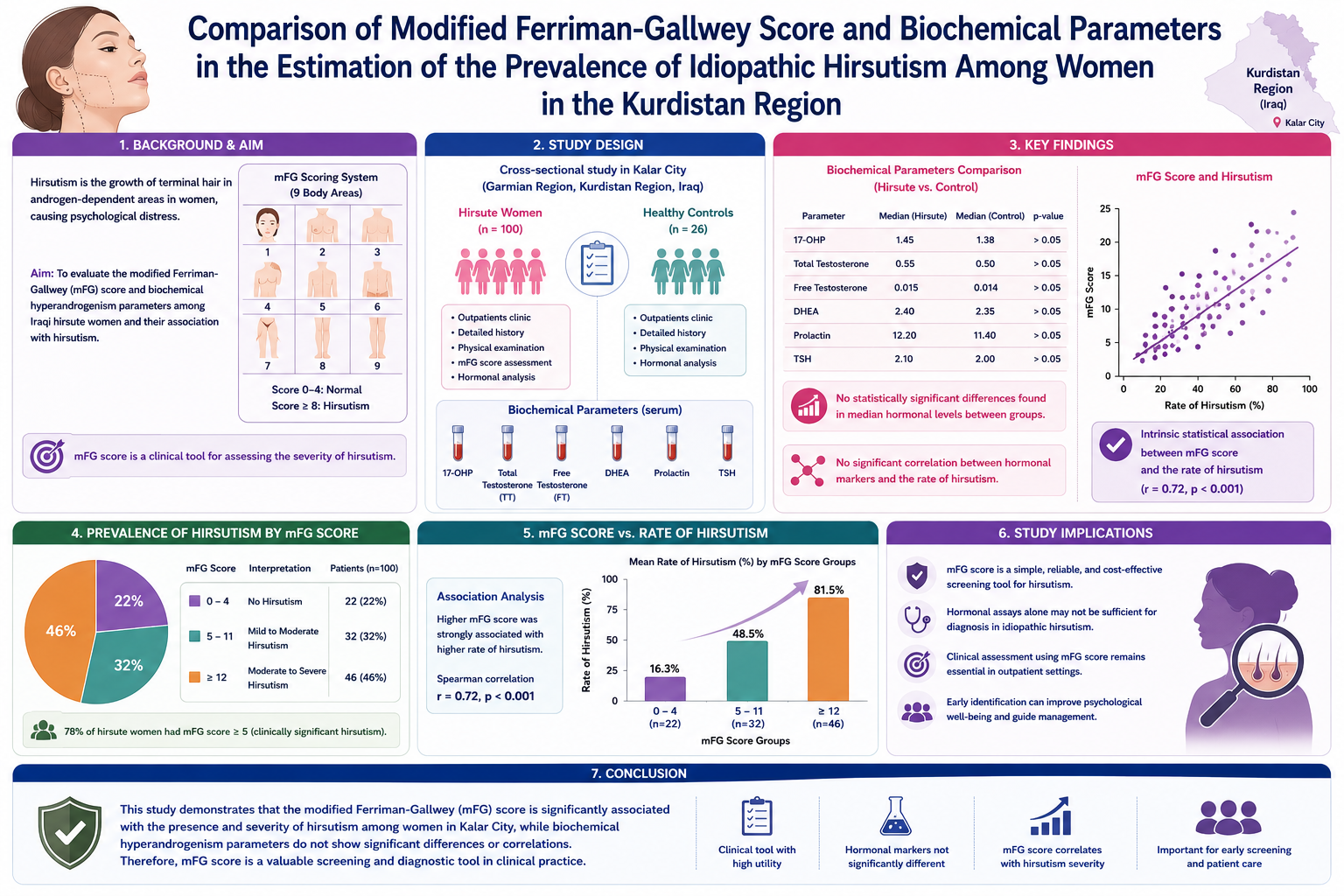
The word "hirsutism" describes the development of terminal hairs at androgen-controlled body locations in women, which has distress and adverse psychosocial affects. The diagnosis of hirsutism is the key point in the treatment of unwanted hair growth in women’s body. Present study aimed to evaluate the modified Ferriman-Gallwey (mFG) score and the biochemical hyperandrogenism parameters among Iraqi hirsute women and their association with hirsutism in outpatients clinics in Kalar city, Garmian region, Iraq. This was a cross-sectional study of 100 hirsute women were collected from the outpatients clinic and 26 healthy women in Kalar city. After detailed history taking by using structured questionnaire, physical examination, and the relevant investigations were done, the scoring of hirsutism was indexed according to (mFG) scoring system. Moreover, sera of hormonal markers were measured; which included 17-hydroxyprogesterone (17-OHP), total testosterone (TT), free testosterone (FT), dehydroepiandrosterone (DHEA), s. prolactin, and thyroid stimulating hormone (TSH). No statistically significant differences were found in the median of the sex and related hormones between control subjects and the hirsutism group. Likewise, there were no significant relation between hormonal markers and the rate of hirsutism. While, an intrinsic statistical association was seen between the mFG score with the hirsutism and the rate of hirsutism. Our findings imply that the mFG score system is a significance screening tool and has tremendous importance and utility in establishing the diagnosis of hirsutism.
Downloads
References
Yildiz BO. Hirsutism: evaluation and treatment. ; 2010. https://doi.org/10.1093/humupd/dmp024. DOI: https://doi.org/10.1093/humupd/dmp024
Escobar-Morreale H. Epidemiology, diagnosis and management of hirsutism: a consensus statement by the Androgen Excess and Polycystic Ovary Syndrome Society. Human reproduction update; 2012. https://doi.org/10.1093/humupd/dmr042. DOI: https://doi.org/10.1093/humupd/dms057
Sachdeva S; 2010. https://doi.org/10.4103/0019-5154.60342. DOI: https://doi.org/10.4103/0019-5154.60342
Lumezi BG. Grading of hirsutism based on the Ferriman-Gallwey scoring system in Kosovar women; 2018. https://doi.org/10.5114/ada.2018.77615. DOI: https://doi.org/10.5114/ada.2018.77615
Lipton MG. Women living with facial hair: the psychological and behavioural burden. Journal of psychosomatic research. 2006;61(2):161–168. https://doi.org/10.1016/j.jpsychores.2006.01.016. DOI: https://doi.org/10.1016/j.jpsychores.2006.01.016
Matheson E, Bain J; 2019. Available from: https://pubmed.ncbi.nlm.nih.gov/ 31361105/.
De Kroon RW, Heijer M, Heijboer AC. Is idiopathic hirsutism idiopathic? Clinica Chimica Acta. 2022;531:17–24. https://doi.org/10.1016/j.cca.2022.03.011. DOI: https://doi.org/10.1016/j.cca.2022.03.011
Franks S. The investigation and management of hirsutism; 2012. https://doi.org/10.1136/jfprhc-2011-100175. DOI: https://doi.org/10.1136/jfprhc-2011-100175
Hafsi W, Badri T. Hirsutism. and others, editor; 2017. Available from: https:// pubmed.ncbi.nlm.nih.gov/29262139/.
Amiri M. Prevalence of idiopathic hirsutism: A systematic review and meta-analysis. Journal of Cosmetic Dermatology. 2022;21(4):1419–1427. https://doi.org/10.1111/jocd.14313. DOI: https://doi.org/10.1111/jocd.14313
Carmina E. Prevalence of idiopathic hirsutism. European journal of endocrinology. 1998;139(4):421–423. https://doi.org/10.1530/eje.0.1390421. DOI: https://doi.org/10.1530/eje.0.1390421
Unluhizarci K. A detailed investigation of hirsutism in a Turkish population: idiopathic hyperandrogenemia as a perplexing issue. Experimental and Clinical Endocrinology & Diabetes. 2004;112(09):504–509. https://doi.org/10.1055/s-2004- 821307. DOI: https://doi.org/10.1055/s-2004-821307
Azziz R. Idiopathic hirsutism: an uncommon cause of hirsutism in Alabama. Fertil- ity and sterility. 1998;70(2):274–278. https://doi.org/10.1016/s0015-0282(98)00141- 1. DOI: https://doi.org/10.1016/S0015-0282(98)00141-1
Ilagan M. The modified Ferriman-Gallwey score and hirsutism among Filipino women. Endocrinology and Metabolism. 2019;34(4):374–381. https://doi.org/10.3803/enm.2019.34.4.374. DOI: https://doi.org/10.3803/EnM.2019.34.4.374
Aswini R, Jayapalan S. Modified Ferriman-Gallwey score in hirsutism and its associ- ation with metabolic syndrome. International journal of trichology. 2017;9(1):7–7. https://doi.org/10.4103/ijt.ijt9316. DOI: https://doi.org/10.4103/ijt.ijt_93_16
Ferriman D, Gallwey J. Clinical assessment of body hair growth in women. The Journal of Clinical Endocrinology & Metabolism. 1961;21(11):1440–1447. https://doi.org/10.1210/jcem-21-11-1440. DOI: https://doi.org/10.1210/jcem-21-11-1440
Hussein RN, Hamdi KI, Mansour AA. Association between biochemi- cal hyperandrogenism parameters and modified Ferriman-Gallwey score in patients with hirsutism in Basrah (Southern Iraq). Advances in Derma- tology and Allergology/Postępy Dermatologii i Alergologii. 2021;38(4):603–607. https://doi.org/10.5114/ada.2021.108907. DOI: https://doi.org/10.5114/ada.2021.108907
Hatch R; 1981. https://doi.org/10.1016/0002-9378(81)90746-8. DOI: https://doi.org/10.1016/0002-9378(81)90746-8
Amiri FN. Female gender scheme is disturbed by polycystic ovary syndrome: A qualitative study from Iran. Iranian Red Crescent Medical Journal. 2014;16(2). https://doi.org/10.5812/ircmj.12423. DOI: https://doi.org/10.5812/ircmj.12423
Crichton N, Information point: prevalence and incidence. Information point: Preva- lence and incidence. Journal of clinical nursing. 2000;9(2):188–188. Available from: https://pubmed.ncbi.nlm.nih.gov/11111608/.
Somani N, Harrison S, Bergfeld WF; 2008. https://doi.org/10.1111/j.1529- 8019.2008.00219.x.
Api M. Interobserver variability of modified Ferriman-Gallwey hirsutism score in a Turkish population. Archives of gynecology and obstetrics. 2009;279:473–479. https://doi.org/10.1007/s00404-008-0747-8. DOI: https://doi.org/10.1007/s00404-008-0747-8
Nourbala M, Kefaei P. 2010;12(2):111–117. Available from: https://pesquisa.bvsalud.
org/portal/resource/pt/emr-93177.
Tehrani FR, Rashidi H, Azizi F. The Prevalence of idiopathic hirsutism and polycystic ovary syndrome in the Tehran Lipid and Glucose Study. Reproductive biology and endocrinology. 2011;9(144):1–8. https://doi.org/10.1186/1477-7827-9-144. DOI: https://doi.org/10.1186/1477-7827-9-144
Erem C. Update on idiopathic hirsutism: diagnosis and treatment. Acta Clinica Belgica. 2013;68(4):268–274. https://doi.org/10.2143/acb.3267. DOI: https://doi.org/10.2143/ACB.3267
Lapidoth M. Best practice options for hair removal in patients with unwanted facial hair using combination therapy with laser: guidelines drawn up by an expert working group. Dermatology. 2010;221(1):34–42. https://doi.org/10.1159/000315499. DOI: https://doi.org/10.1159/000315499
Azziz R. The evaluation and management of hirsutism. Obstetrics & Gynecology. 2003;101(5):995–1007. https://doi.org/10.1016/s0029-7844(02)02725-4. DOI: https://doi.org/10.1016/S0029-7844(02)02725-4
Dewhurst J. 9th ed. and others, editor. John Wiley & Sons; 2012. Available from: https://www.wiley.com/en-jp/Dewhurst’s+Textbook+of+Obstetrics+&+ Gynaecology,+9th+Edition-p-9781119211426.
Karrer-Voegeli S. Androgen dependence of hirsutism, acne, and alopecia in women: retrospective analysis of 228 patients investigated for hyperandrogenism. Medicine. 2009;88(1):32–45. https://doi.org/10.1097/md.0b013e3181946a2c. DOI: https://doi.org/10.1097/md.0b013e3181946a2c
Ozdemir D, Cuhaci N, Balkan F. Bioscientifica; 2011. Available from: https://www.endocrine-abstracts.org/ea/0026/ea0026p92.
Kamrul-Hasan A, Aalpona AB, Zahura FT. Prevalence of thyroid dysfunction and thyroid autoimmunity in polycystic ovary syndrome: A multicenter study from Bangladesh Thyroid Research and Practice. 2020;17(2):76–81. DOI:10.4103/trp.trp620. DOI: https://doi.org/10.4103/trp.trp_6_20
Singla R. Thyroid disorders and polycystic ovary syndrome: An emerging relationship. Indian journal of endocrinology and metabolism. 2015;19(1):25–25. https://doi.org/10.4103/2230-8210.146860. DOI: https://doi.org/10.4103/2230-8210.146860
Kopera D, Wehr E, Obermayer-Pietsch B. Endocrinology of hirsutism International journal of trichology. 2010;2(1):30–35. https://doi.org/10.4103/0974-7753.66910. DOI: https://doi.org/10.4103/0974-7753.66910
Additional Files
Published
Issue
Section
Categories
License
Copyright (c) 2022 Bushra Maree jarallah , Hataw Adil, Ayad Palani

This work is licensed under a Creative Commons Attribution 4.0 International License.
The authors retain all proprietary rights, including copyright, such as patent and trademark rights and rights to any process or procedure described in the article.